Guide · Bullion Investing
Buying Silver Bullion: A Beginner’s Guide
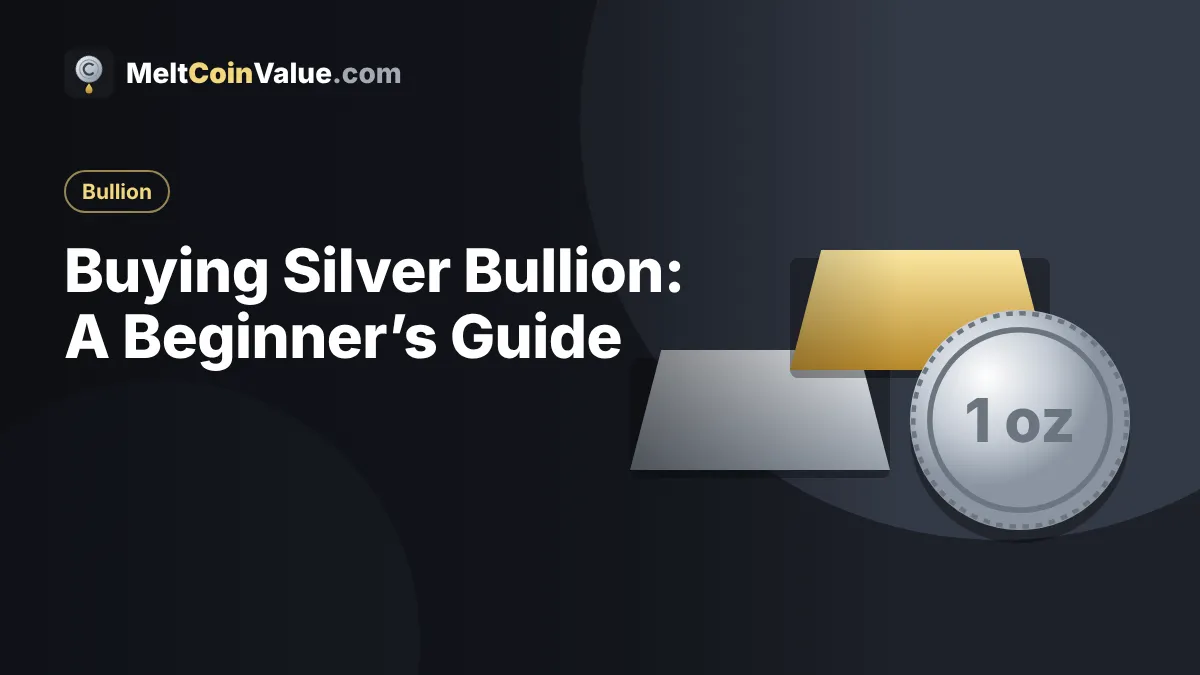
Buying silver bullion means paying for pure silver by the troy ounce, in the form of government coins, private rounds or bars. You'll always pay the spot price plus a dealer premium, so the smartest first purchase is usually a few well-known one-ounce pieces from a reputable dealer, bought after you've compared the total cost per ounce. Spot silver is $52.07 per troy ounce right now.
That's the short version. The rest of this guide walks through the decisions in the order you'll actually face them, from picking a product to storing it and, one day, selling it.
Step 1. Know what you're paying for
Every silver bullion product is priced off one number: the spot price, which is the wholesale price for immediate delivery of large bars. Precious metals trade nearly 24 hours a day, from Sunday 6 pm to Friday 5 pm New York time, so the number moves while you shop.
Here's the live silver price our site tracks, with today's change.
Silver spot price per troy ounce (USD)
$52.07
▼ −$0.59 (-1.13%) vs previous close
No retail buyer pays spot. A dealer adds a premium to cover minting, shipping, insurance, overhead and profit. If you want the full breakdown, read our guide to why bullion costs more than spot. For now, the rule is simple: compare products by their total price per troy ounce, not by the sticker on each item.
And remember the unit. Bullion is weighed in troy ounces of 31.1035 grams, about 10% heavier than the 28.3495-gram ounce on your kitchen scale. Our explainer on troy ounces vs regular ounces covers the conversions.
Step 2. Pick a product type
Silver bullion comes in three main shapes. Each has a job it does well.
| Product | What it is | Best for | Trade-off |
|---|---|---|---|
| Government bullion coins | Coins like the American Silver Eagle (.999) or Canadian Silver Maple Leaf (.9999) | Easy recognition and resale, IRA eligibility | Usually the highest premium per ounce |
| Silver rounds | Coin-shaped pieces from private mints, no face value | Lower cost per ounce in one-ounce units | Less recognizable; buyers may pay a bit less |
| Silver bars | Poured or minted bars from 1 oz up to 100 oz and kilo sizes | Lowest premium per ounce in bigger sizes | Large bars must be sold whole |
| 90% "junk" silver | Pre-1965 US dimes, quarters and halves | Small, familiar units | Not .999, so not IRA eligible |
If you're torn between the first two rows, our side-by-side on silver rounds vs silver coins goes deeper. If old US coins appeal more, the comparison of junk silver vs silver bullion lays out when 90% coins make sense.
A sensible first purchase
For most beginners, a handful of one-ounce government coins is the easiest place to start. The American Silver Eagle is the one nearly every US dealer knows on sight: 31.103 grams of .999 silver, made since 1986. You'll pay more per ounce than for a bar, but you'll never have to explain to a buyer what it is.
Once you know you like owning silver, bars become more attractive. A 10 oz bar typically carries a smaller premium per ounce than ten separate coins.
This table pulls the live melt value for common bullion coins, so you can see what the metal alone is worth before any premium.
| Coin | Years | Metal content | Melt value | × face |
|---|---|---|---|---|
 American Silver Eagle (1 oz) | 1986–present | 0.9990 oz silver | $52.02 | 52.0× |
 American Gold Eagle (1 oz) | 1986–present | 1.0000 oz gold | $4,073.84 | 81.5× |
 American Gold Eagle (1/2 oz) | 1986–present | 0.5000 oz gold | $2,036.98 | 81.5× |
 American Gold Eagle (1/4 oz) | 1986–present | 0.2500 oz gold | $1,018.49 | 101.8× |
 American Gold Eagle (1/10 oz) | 1986–present | 0.1000 oz gold | $407.37 | 81.5× |
 American Gold Buffalo (1 oz) | 2006–present | 1.0000 oz gold | $4,072.29 | 81.4× |
 American Platinum Eagle (1 oz) | 1997–present | 1.0000 oz platinum | $1,544.05 | 15.4× |
 American Palladium Eagle (1 oz) | 2017–present | 1.0000 oz palladium | $1,044.03 | 41.8× |
 Canadian Silver Maple Leaf (1 oz) | 1988–present | 1.0001 oz silver | $52.08 | — |
 Canadian Gold Maple Leaf (1 oz) | 1979–present | 1.0001 oz gold | $4,072.55 | — |
 South African Krugerrand (1 oz) | 1967–present | 1.0000 oz gold | $4,072.03 | — |
 British Silver Britannia (1 oz) | 2013–present | 1.0024 oz silver | $52.20 | — |
Melt value = metal content × today’s spot price. It is not what a dealer pays (usually less) or a collector’s price (often more).
Step 3. Do the cost-per-ounce math
Sticker prices hide the real cost. Shipping, payment fees and minimum orders all change what you pay per ounce. Here's a worked example with round numbers, not today's prices.
Say silver spot is $40 an ounce and Marisol is choosing between two offers:
- Offer A: 20 one-ounce government coins at $46 each, free shipping. Total: $920 for 20 ounces, or $46.00 per ounce ($6 over spot).
- Offer B: two 10 oz bars at $430 each, plus $15 shipping. Total: $875 for 20 ounces, or $43.75 per ounce ($3.75 over spot).
Offer B saves her $45 today. But if she might need to sell a few ounces at a time later, the coins give her flexibility the bars can't. Cheapest per ounce isn't automatically best. It depends on how you expect to sell.
Our bullion value calculator does the spot side of this math for any weight and purity, so you can see how far above melt a quote really is.
Step 4. Choose where to buy
You have three realistic options. Each has a different mix of price, speed and risk.
- Local coin shop. You see the product, pay, and walk out with it. No shipping, no waiting. Prices can be higher than big online sellers, but you can ask questions and build a relationship that helps when you sell.
- Large online dealer. Often the lowest premiums, especially on bars and tubes of coins. Prices commonly differ by payment method, so check the cash or bank-wire price against the card price.
- Coin shows. Many dealers in one room, which makes comparison shopping easy.
Whichever you choose, avoid anyone using high-pressure tactics, pushing "special" collectible coins as investments, or offering silver well below spot. Too-cheap silver usually means fake silver or a payment scam.
Step 5. Plan storage before the box arrives
Silver is bulky for its value. A few hundred ounces fills a shoebox and gets heavy fast. Decide where it will live before you buy:
- A home safe bolted down, out of sight, with a check on whether your homeowner's policy covers it.
- A bank safe deposit box, which is private but only open during bank hours. Ask the bank, and your insurer, what coverage applies to the contents.
- A private vault, which charges fees but usually includes insurance.
Keep coins in their original tubes or capsules and handle them by the edges. Silver tarnishes, and while toning doesn't change the metal content, a clean-looking bullion coin is easier to sell. Our guide to storing bullion at home or in a vault compares the options in more detail.
Step 6. Understand the tax side
The IRS treats coins and bullion as collectibles. Long-term gains on silver held more than one year are taxed at a maximum federal rate of 28%, and short-term gains at ordinary income rates. State sales tax on bullion varies by state, so the same order can cost different amounts depending on where it ships.
Keep every receipt. Without a purchase record, you can't prove your cost basis when you sell. Our page on taxes on gold and silver bullion has more, and a tax adviser can confirm how the rules apply to you.
Step 7. Think about the exit
A buyer will pay less than the retail price you paid, because dealers buy below their selling price. That gap is the real cost of owning physical silver. The more recognizable your product, and the more sizes you hold, the easier selling becomes.
So a mixed stack has a quiet advantage. Bars for the bulk of your ounces, coins for flexibility.
Your first-purchase checklist
- Check the live silver spot price before you shop.
- Decide on a product: one-ounce government coins are the easiest start.
- Get two or three quotes and convert each to total cost per troy ounce, including shipping and payment fees.
- Buy from a dealer with a physical address and a clear buyback policy.
- Have storage ready before delivery.
- Save the invoice in a folder you'll still find years from now.
- Buy an amount you're comfortable holding through price drops. Silver can swing hard in either direction.
None of this is investment advice. Silver can fall as well as rise, and physical metal pays no interest. Treat it as one part of a bigger financial picture, and size your purchases to match.
Written by Editorial Team and checked against official sources under our editorial policy. Spotted an error? See our corrections policy.