Guide · Metal Prices Explained
What Moves Silver Prices? 7 Main Drivers
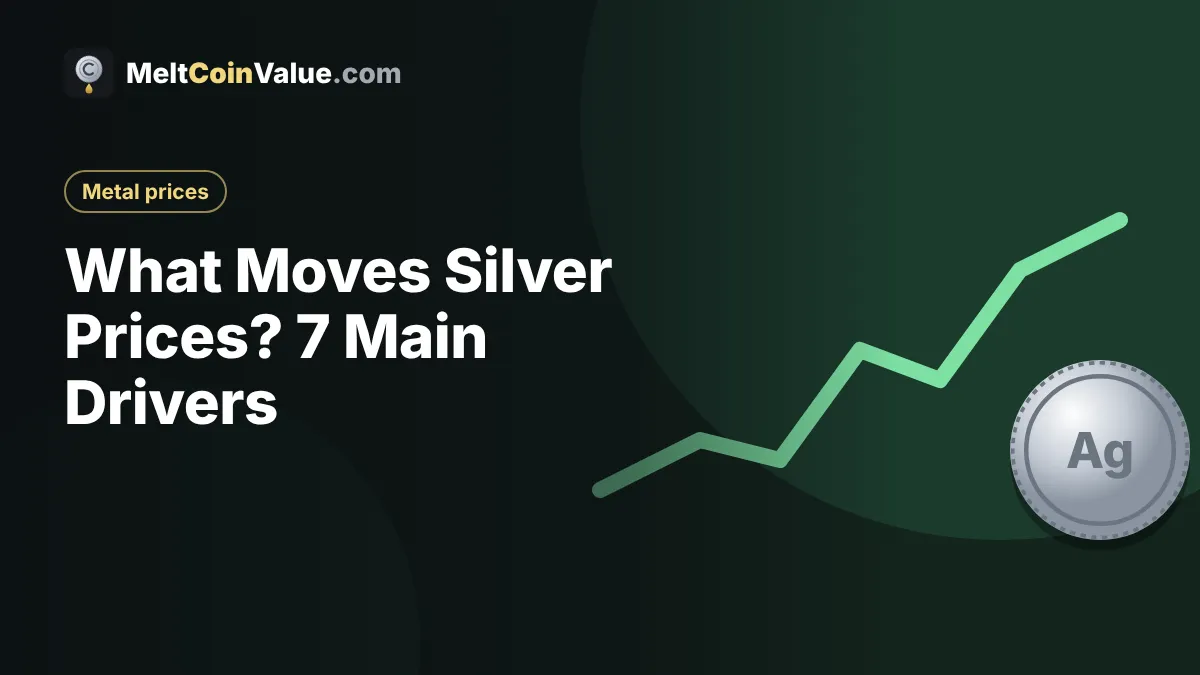
Silver prices are driven by seven main forces: industrial demand, investment buying, the US dollar, interest rates, mine and recycling supply, gold's direction (seen through the gold/silver ratio) and plain market sentiment. Because silver is both an industrial metal and a store of value, it gets pulled by factory orders and by fear at the same time. That mix is why it can sit quietly for months and then jump or slide sharply in a week.
Spot silver is $51.96 per troy ounce right now, a move of -0.22% today. The card below shows the live price with its daily change.
Silver spot price per troy ounce (USD)
$51.96
▼ −$0.11 (-0.22%) vs previous close
Why silver doesn't follow one simple rule
Gold mostly trades as money. Copper mostly trades as a factory input. Silver is caught between the two, so on any given day it may act like either one.
On a calm day with strong economic news, silver can rise alongside industrial metals. On a scary day with bad news, it can rise alongside gold. And on some days those two pulls cancel out. If you've ever watched gold climb while silver went nowhere, that's the tug-of-war in action.
The seven drivers below are listed roughly from the slowest-moving to the fastest. None of them works alone, and none gives a reliable forecast on its own.
1. Industrial demand
Silver conducts electricity and heat better than any other metal, and it reflects light well. That's why it ends up in solar panels, electrical contacts, circuit boards, batteries, medical products and mirrors. A large share of the silver used each year goes into these products rather than into vaults.
When manufacturing is busy, buyers need more metal. When factories slow down in a recession, that demand softens. Industrial users also tend to buy what they need, when they need it, so their demand shifts gradually over quarters and years rather than minute to minute. Our guide to silver's industrial uses goes through the main sectors.
The thrift effect
High prices push manufacturers to use less silver per product, a habit the industry calls thrifting. So a big price rise can slowly trim some of the very demand that caused it.
2. Investment buying and selling
Investors buy silver as coins, bars, rounds, junk silver and exchange-traded funds. This money can arrive and leave much faster than industrial demand.
- Physical buyers pick up Silver Eagles, 100 oz bars and $1,000 face bags of 90% coins. Heavy retail demand tends to show up first as higher premiums and dealer backorders.
- Fund flows into and out of silver-backed funds move larger sums and can shift the spot price within a session.
- Futures traders buy and sell contracts without wanting delivery. Their positioning can amplify short-term moves in both directions.
Investment demand is the swing factor. It's often the reason silver overshoots on the way up and on the way down.
3. The US dollar
Silver is priced worldwide in US dollars. When the dollar weakens against other currencies, an ounce of silver becomes cheaper for buyers paying in euros, yen or rupees, which can lift demand and the dollar price. A stronger dollar tends to do the opposite.
The relationship is a tendency, not a law. There are stretches when both rise together, usually during a global scare when people want dollars and metal at once. Our explainer on why gold usually moves opposite the dollar covers the exceptions, and the same logic applies to silver.
4. Interest rates
A silver bar pays no interest. When savings accounts and Treasury bills pay well, holding metal has a higher opportunity cost, and some investors move money out. When rates fall, especially after inflation, that cost shrinks and metals can look more appealing.
What traders watch most is the real rate: the interest rate minus inflation. That's why a Federal Reserve meeting can move silver in minutes. The details are in our guide on how interest rates affect gold and silver.
5. Supply from mines and recycling
Much of the world's silver comes out of the ground as a byproduct of mining other metals such as copper, lead, zinc and gold. That matters: a mine producing mostly copper won't dig more just because silver went up. So supply responds slowly to price.
Recycling adds metal from old jewelry, flatware, electronics and coins. When prices rise, more people sell sterling forks and junk silver, which adds supply at the margin. Mine strikes, new projects and changes in base-metal mining can all shift the picture over a period of years.
6. Gold's direction and the gold/silver ratio
Silver often follows gold's lead, just with bigger swings. Many traders watch the gold/silver ratio, which is how many ounces of silver one ounce of gold buys. Today it stands at 78.2.
When the ratio is high by historical standards, some investors see silver as relatively cheap and swap toward it; when it's low, some swap back toward gold. Those swaps can nudge prices. You can track it on our live gold/silver ratio page, and the guide to the gold/silver ratio explained shows how people use it.
7. Sentiment, news and momentum
Silver is a smaller market than gold, so headlines move it more. Talk of shortages, social media buying campaigns, geopolitical shocks and big futures positions can push prices further than the fundamentals alone would suggest. Momentum feeds on itself for a while, then reverses. That's a big part of why silver is more volatile than gold.
The five-year chart below shows how often silver moves in bursts rather than straight lines.
Silver price chart (USD per troy oz)
Over the past five years, silver moved from $24.34 to $51.96 per troy ounce (+113.42%), with a high of $115.08 and a low of $17.77 (daily closes).
Which driver matters on which timescale?
| Driver | Usually moves price over | Pushes price up when |
|---|---|---|
| Industrial demand | Months to years | Manufacturing and new uses grow |
| Investment flows | Days to months | Buyers pour into coins, bars and funds |
| US dollar | Days to months | The dollar weakens |
| Interest rates | Hours to months | Real rates fall or are expected to fall |
| Supply | Years | Mine output or recycling shrinks |
| Gold and the ratio | Days to months | Gold rises or the ratio narrows |
| Sentiment | Minutes to weeks | Fear, hype or momentum builds |
What a price move means for the coins in your drawer
Price drivers feel abstract until you put them in coin terms. Here's a worked example with round numbers.
Say you have a $10 face roll of 40 Washington quarters dated 1964 or earlier. Each holds 0.18084 troy ounces of silver, so the roll holds about 7.23 ounces. If silver is $40 an ounce, that's about $289 of metal. If a weak-dollar week pushes silver up $2, the roll gains about $14.47 in melt value. A $2 drop takes the same amount away.
Scale that up and the swings get real. A $1,000 face bag of worn 90% coins is figured at about 715 ounces, so each $1 move in silver changes its melt value by roughly $715. At today's price, one silver quarter holds $9.40 in silver, and $1 face of 90% coins is worth about $37.15. Run your own numbers on the junk silver calculator.
Remember that a dealer buying your coins pays a percentage of melt, and a dealer selling to you charges a premium above it. Spot moves change both numbers, but not the gap between them.
Common mistakes when reading silver news
- Treating one driver as the whole story. A strong dollar day can still be an up day for silver if gold is surging.
- Confusing spot with what you'll pay. Retail coins and bars sell above spot; see our explainer on what the spot price really is.
- Trusting confident forecasts. Nobody can reliably call the next move. Price targets are guesses dressed as data.
- Reacting to a single day. Daily swings of a few percent are normal for silver. Zoom out before deciding anything.
Quick checklist before you buy or sell
- Check live spot on our silver price page, not a stale quote.
- Note which way the dollar and interest rate expectations are leaning this week.
- Look at the ratio to see whether silver is moving with gold or on its own.
- Work out melt value for what you hold, then compare dealer offers as a percentage of it.
- Decide based on your own goals and time frame. This guide explains price drivers; it isn't investment advice.
Written by Editorial Team and checked against official sources under our editorial policy. Spotted an error? See our corrections policy.